
What Is the Difference Between surface mount technology vs through hole?
author: Shirley Xie
2025-06-18
Printed Circuit Board (PCB) assembly is the foundation of modern electronics, and two primary methods dominate this landscape: surface mount technology vs through hole. These two technologies represent distinct approaches to placing and soldering components on a PCB, each with its advantages, limitations, and areas of best use. Understanding these differences is essential for electronics engineers, manufacturers, and those involved in semiconductor device packaging.

Understanding Through-Hole Technology (THT)
Definition and Process
Through-hole technology involves inserting electronic components with leads into drilled holes on the PCB. The leads are soldered on the opposite side of the board, ensuring a strong mechanical connection.
Applications
-
Power electronics
-
Military-grade hardware
-
Aerospace and automotive electronics
-
Large components such as transformers and capacitors
Advantages
-
High mechanical strength
-
Durable under stress and vibration
-
Ideal for prototyping and testing
Limitations
-
Slower manufacturing process
-
Requires drilling, which increases production costs
-
Larger board space requirements
What Is Surface Mount Technology (SMT)?
Definition and Process
Surface mount technology eliminates the need for hole drilling. Components are mounted directly onto the PCB surface using solder paste and reflow soldering processes.
Applications
-
Consumer electronics
-
Computers and mobile devices
-
LED lighting systems
-
Communication equipment
Advantages
-
Faster production with automated machines
-
Supports high component density
-
Reduces PCB size and weight
-
Lower material and labor cost
Limitations
-
Not suitable for high mechanical stress
-
Repair and manual handling can be difficult
-
May require specialized soldering systems for void-free results
Surface Mount Technology vs Through Hole: Key Differences
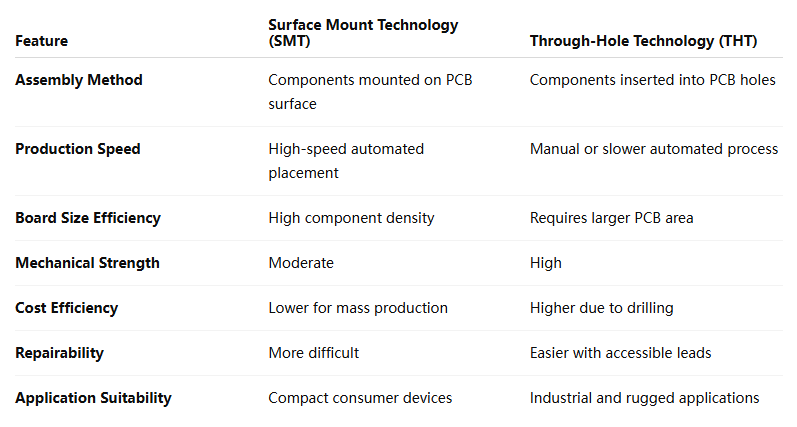
The comparison of surface mount technology vs through hole helps identify the appropriate assembly method for different electronic applications.
Role of Vacuum Soldering in SMT and THT
With increasing demand for miniaturization and performance, advanced soldering methods like vacuum reflow soldering are critical in ensuring quality and reliability—especially for SMT components.
Vacuum Soldering System KD-V200HVT
The KD-V200HVT is a specialized vacuum reflow oven designed to eliminate voids during the soldering process. This system enhances solder joint reliability, which is crucial in SMT assemblies where consistent thermal and electrical performance is required.
Formic Acid Vacuum Reflow Oven
Using formic acid as a reducing agent improves wetting and removes oxidation, which is especially effective in SMT processes. It enhances the soldering quality of fine-pitch components, often used in high-speed communication and computing devices.
Inline Vacuum Soldering Systems
High-volume production lines benefit from inline vacuum soldering systems, offering automatic flux reduction, void removal, and consistent reflow profiles. These systems are ideal for power semiconductor packaging and large-scale SMT production environments.
Design and Manufacturing Considerations
Thermal Management
THT components typically manage heat better due to stronger physical connections, but SMT devices rely on copper planes and vias to dissipate heat efficiently.
Signal Integrity
In high-frequency applications, SMT offers shorter signal paths and less inductance, benefiting signal speed and clarity—key for RF and digital designs.
Automation Compatibility
Surface mount technology is far more compatible with full automation, from pick-and-place to automated optical inspection (AOI). THT often requires manual steps.
When to Choose SMT Over THT (and Vice Versa)
Use SMT When:
-
You need compact, lightweight, high-density PCB layouts
-
Speed and cost are priorities
-
Applications demand high-speed data and low EMI
Use THT When:
-
Mechanical stability is critical
-
Components generate high heat or stress
-
Prototypes or small batches require easy modification
Combining both technologies (known as mixed-technology PCB) is also common—using THT for connectors and large components, and SMT for integrated circuits and passive elements.
Industry Trends and the Future
The evolution of electronics continues to push boundaries. Miniaturization, 5G, AI chips, and smart wearables demand even more precision from PCB assembly processes. Vacuum soldering, void-free solutions, and intelligent process control are no longer optional but essential.
Companies like Chengliankaida Technology Co., LTD, working closely with the IGBT industry and leading research institutions, are at the forefront of developing reliable, advanced packaging and soldering solutions for power devices.
Conclusion
The debate of surface mount technology vs through hole is less about which is better and more about choosing the right tool for the job. SMT offers speed, size, and automation, while THT provides strength and stability. When combined with modern vacuum reflow technologies such as the Vacuum Soldering System KD-V200HVT, Formic Acid Vacuum Reflow Oven, and Inline Vacuum Soldering Systems, manufacturers can achieve unmatched quality in both SMT and THT assemblies.
What Is a Formic Acid Reflow Oven and Why Is It Crucial in Semiconductor Packaging?
What Is Reflow Soldering in Surface-Mount Technology?
Related Article

Explore laser packaging process routes for LiDAR and optoelectronics. Discover how vacuum eutectic soldering secures sub-micron alignment stability.
Laser Diode Packaging Technologies: From TO-Can to Silicon Photonics

Compare inline vs. batch vacuum soldering systems. Learn how vacuum reflow ovens optimize void-free welding for high-power semiconductor packaging.
Vacuum Soldering Process & Equipment Comparison: How to Achieve Automotive-Grade Low-Void Manufacturing

