
Reducing Voiding with Continuous Vacuum Reflow
2023-09-28
Vacuum reflow is a method used in electronics that's gaining more attention. It helps reduce problems with solder joints and thermal pads.
Initially, vacuum reflow involved putting boards in a special chamber and heating them to melt the solder. While heating, the chamber was made empty (or vacuumed), which reduced or sometimes removed any gaps in the solder.
Sometimes, vacuum was applied when the solder started melting, and other times it was used throughout the heating process. But this equipment was costly and slow, which made it unsuitable for high-volume production.
People also questioned whether voids (those gaps) really needed to be removed. Some even thought a few voids made joints stronger.
So, vacuum reflow wasn't very popular until there was a need to cool high-power components, especially in cars. At first, vias (tiny holes) seemed like a solution, but it was hard to ensure they'd be in the right spot under the hottest part of the component. That's why having almost no voids in thermal pads became important.
"Low voiding" means having anywhere from 20 percent to none at all, with many aiming for just 5 percent. It's been tough to go from 40 percent voiding to 20 percent or less, especially in high-volume production. Changes to solder paste and heating profiles have helped, but consistently getting below 5 percent has been a challenge.
One solution is using a continuous vacuum-assisted reflow oven. It's like a regular oven, but it has a vacuum chamber between the last heating part and the cooling part. But this setup brings some difficulties, like moving the board in and out of the chamber, making sure the vacuum section seals properly, and applying vacuum at high temperatures.
There are different designs for the vacuum chamber inside, using either doors or bell jars. Doors are lightweight and easy to move, while bell jars make it simple to access the conveyor system inside.
The transport system has its own issues because the edge rails have to be interrupted for the door or bell to seal. Plus, the board needs to stop in the chamber while vacuum is applied. And in all cases, the sealing material has to handle temperatures that can reach 662°F (350°C).
Initially, vacuum reflow involved putting boards in a special chamber and heating them to melt the solder. While heating, the chamber was made empty (or vacuumed), which reduced or sometimes removed any gaps in the solder.
Sometimes, vacuum was applied when the solder started melting, and other times it was used throughout the heating process. But this equipment was costly and slow, which made it unsuitable for high-volume production.
People also questioned whether voids (those gaps) really needed to be removed. Some even thought a few voids made joints stronger.
So, vacuum reflow wasn't very popular until there was a need to cool high-power components, especially in cars. At first, vias (tiny holes) seemed like a solution, but it was hard to ensure they'd be in the right spot under the hottest part of the component. That's why having almost no voids in thermal pads became important.
"Low voiding" means having anywhere from 20 percent to none at all, with many aiming for just 5 percent. It's been tough to go from 40 percent voiding to 20 percent or less, especially in high-volume production. Changes to solder paste and heating profiles have helped, but consistently getting below 5 percent has been a challenge.
One solution is using a continuous vacuum-assisted reflow oven. It's like a regular oven, but it has a vacuum chamber between the last heating part and the cooling part. But this setup brings some difficulties, like moving the board in and out of the chamber, making sure the vacuum section seals properly, and applying vacuum at high temperatures.
There are different designs for the vacuum chamber inside, using either doors or bell jars. Doors are lightweight and easy to move, while bell jars make it simple to access the conveyor system inside.
The transport system has its own issues because the edge rails have to be interrupted for the door or bell to seal. Plus, the board needs to stop in the chamber while vacuum is applied. And in all cases, the sealing material has to handle temperatures that can reach 662°F (350°C).
Continuous Vacuum Reflow
When you first heat things up in a continuous vacuum reflow, it's just like using a regular oven. Things like how quickly the heat spreads, the temperature settings, and how fast the board moves on the conveyor belt, all play a role in heating the board.
But when the board starts going into the vacuum chamber, we lose that even heat from the regular oven, and we have to rely on something else called radiation. Once the board's inside the vacuum chamber, we control four things: how fast we suck the air out (that's the pump down rate), how much vacuum we expose the board to, how long we keep that vacuum going, and how quickly we bring everything back to normal air pressure (that's the equalization rate).
The pump down rate is how fast we create the vacuum. If we do it too fast, those voids (those gaps we want to get rid of) can burst and create little balls of solder or splatter. If it's too slow, it just takes a lot of time, and the time the board spends above liquidus (that's the melting point of the solder) gets longer.
The vacuum level is how strong the vacuum is. It can be as low as 1 Torr or as high as 250 Torr. But even with really big vacuum pumps, going to low vacuum levels takes more time.
Vacuum hold time is how long we keep the board in that vacuum. It can be really short, like just a second, or it can be a few minutes. At 1 second, there's not much time for those voids to get out, and it's been shown that more than 40 seconds isn't really needed.
Equalization rate is how quickly we bring things back to normal air pressure. So, if we had a super low vacuum level, it takes longer to get back to regular air pressure.
Now, when we talk about how long this vacuum part of the reflow process takes, we add up these four things I mentioned earlier plus the time it takes to move the board in and out of the chamber.
When you first heat things up in a continuous vacuum reflow, it's just like using a regular oven. Things like how quickly the heat spreads, the temperature settings, and how fast the board moves on the conveyor belt, all play a role in heating the board.
But when the board starts going into the vacuum chamber, we lose that even heat from the regular oven, and we have to rely on something else called radiation. Once the board's inside the vacuum chamber, we control four things: how fast we suck the air out (that's the pump down rate), how much vacuum we expose the board to, how long we keep that vacuum going, and how quickly we bring everything back to normal air pressure (that's the equalization rate).
The pump down rate is how fast we create the vacuum. If we do it too fast, those voids (those gaps we want to get rid of) can burst and create little balls of solder or splatter. If it's too slow, it just takes a lot of time, and the time the board spends above liquidus (that's the melting point of the solder) gets longer.
The vacuum level is how strong the vacuum is. It can be as low as 1 Torr or as high as 250 Torr. But even with really big vacuum pumps, going to low vacuum levels takes more time.
Vacuum hold time is how long we keep the board in that vacuum. It can be really short, like just a second, or it can be a few minutes. At 1 second, there's not much time for those voids to get out, and it's been shown that more than 40 seconds isn't really needed.
Equalization rate is how quickly we bring things back to normal air pressure. So, if we had a super low vacuum level, it takes longer to get back to regular air pressure.
Now, when we talk about how long this vacuum part of the reflow process takes, we add up these four things I mentioned earlier plus the time it takes to move the board in and out of the chamber.
Vacuum Trial Results
Mike Meilunas from Universal Instruments' Advanced Process Lab (APL), with help from BTU, created a special test board to study voids. This board had different-sized thermal pads, resistors, and D2PAKs, which are electronic components. They wanted to see how using different levels of vacuum and holding the vacuum for various amounts of time would affect the tiny gaps (voids) in the thermal pads. They used a specific way of heating the board to high temperatures, and they tried different vacuum settings and times. By looking at X-ray images, they discovered that the size of the thermal pad, the vacuum level, and how long they held the vacuum all had an impact on the voids. They found that using 20 Torr in their trials resulted in the fewest voids.
They also noticed a problem when dealing with small, closely-packed electronic components (CSPs) under strong vacuum conditions. Instead of the voids escaping, they sometimes made the tiny balls of solder expand and stick together, which could lead to problems like short circuits. They even tried dipping the CSPs in flux, but that made things worse.
While the electronics industry mainly focuses on how many voids there are in thermal pads, Mike Meilunas thought that where the voids are and how big they are might be more important. He looked at QFN100s at different vacuum levels and found that once the vacuum went below 120 Torr, there was a very low chance of having a void that was larger than 15 percent of the total size.
So, their research showed that using vacuum reflow is a great way to reduce the number of voids in thermal pads of electronic components. They achieved levels below 5 percent when they held the vacuum for 20 seconds and used 20 Torr. Even using a relatively gentle vacuum at 120 Torr with short vacuum times still helped a lot in decreasing the voids.
Mike Meilunas from Universal Instruments' Advanced Process Lab (APL), with help from BTU, created a special test board to study voids. This board had different-sized thermal pads, resistors, and D2PAKs, which are electronic components. They wanted to see how using different levels of vacuum and holding the vacuum for various amounts of time would affect the tiny gaps (voids) in the thermal pads. They used a specific way of heating the board to high temperatures, and they tried different vacuum settings and times. By looking at X-ray images, they discovered that the size of the thermal pad, the vacuum level, and how long they held the vacuum all had an impact on the voids. They found that using 20 Torr in their trials resulted in the fewest voids.
They also noticed a problem when dealing with small, closely-packed electronic components (CSPs) under strong vacuum conditions. Instead of the voids escaping, they sometimes made the tiny balls of solder expand and stick together, which could lead to problems like short circuits. They even tried dipping the CSPs in flux, but that made things worse.
While the electronics industry mainly focuses on how many voids there are in thermal pads, Mike Meilunas thought that where the voids are and how big they are might be more important. He looked at QFN100s at different vacuum levels and found that once the vacuum went below 120 Torr, there was a very low chance of having a void that was larger than 15 percent of the total size.
So, their research showed that using vacuum reflow is a great way to reduce the number of voids in thermal pads of electronic components. They achieved levels below 5 percent when they held the vacuum for 20 seconds and used 20 Torr. Even using a relatively gentle vacuum at 120 Torr with short vacuum times still helped a lot in decreasing the voids.
Recommended Vacuum Reflow Oven
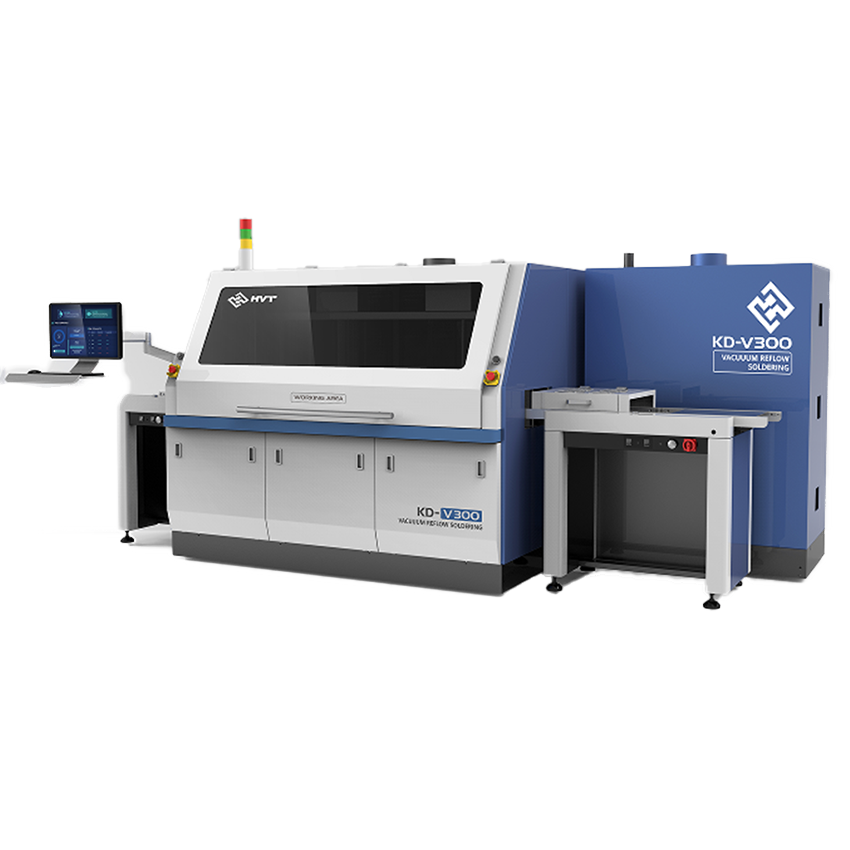


Vacuum reflow soldering is a key technology used in the production of new energy vehicles.
Which Reflow Oven Size Do You Need?
Related Article

Explore laser packaging process routes for LiDAR and optoelectronics. Discover how vacuum eutectic soldering secures sub-micron alignment stability.
Laser Diode Packaging Technologies: From TO-Can to Silicon Photonics

Compare inline vs. batch vacuum soldering systems. Learn how vacuum reflow ovens optimize void-free welding for high-power semiconductor packaging.
Vacuum Soldering Process & Equipment Comparison: How to Achieve Automotive-Grade Low-Void Manufacturing

