
Which Selective Soldering Station is Best for Your PCB Line?
author: Shirley Xie
2025-08-27
What is a Selective Soldering Station and How Does It Work?
Selective soldering stations are advanced machines designed to apply solder precisely to specific areas of a printed circuit board (PCB), targeting through-hole components without affecting nearby surface-mount technology (SMT) parts. Unlike wave soldering, which floods entire boards with molten solder, selective soldering stations use targeted methods like mini-wave nozzles, laser soldering, or drop-jet fluxers to minimize thermal stress and ensure high-quality joints.

The Selective Soldering Process
The process typically involves three stages:
-
Flux Application: A precise amount of flux is applied to designated solder joints, often using drop-jet or ultrasonic systems to ensure accuracy and reduce waste.
-
Preheating: The PCB is preheated to activate the flux and prepare components for soldering, typically using infrared or convection systems to avoid thermal shock.
-
Soldering: A selective soldering station uses a localized solder fountain or laser to apply molten solder to specific joints, often under a nitrogen atmosphere to prevent oxidation.
This precision makes selective soldering stations ideal for complex, high-mix PCB assemblies where reliability is critical, such as in automotive, aerospace, and semiconductor industries.
Selective Soldering vs. Other Methods
-
Wave Soldering: Best for high-volume, uniform boards but risks damaging sensitive components due to full-board solder exposure.
-
Hand Soldering: Offers flexibility but is labor-intensive, inconsistent, and impractical for large-scale production.
-
Reflow Soldering: Suited for SMT but not ideal for through-hole components, where selective soldering stations excel.
By addressing these challenges, selective soldering stations ensure consistent, void-free solder joints, critical for applications like power electronics and semiconductor packaging.
Why Are Selective Soldering Stations Essential for Modern PCB Assembly?
The demand for compact, reliable electronics has surged, with global PCB production expected to grow at a 5.3% CAGR through 2030, driven by industries like 5G, electric vehicles, and IoT devices. Selective soldering stations meet these needs by offering unmatched precision and adaptability.
Key Benefits of Selective Soldering Stations
-
Precision and Quality: Selective soldering stations target individual joints, reducing defects like bridging or incomplete soldering. This is vital for hermetic sealing in semiconductor devices.
-
Efficiency in High-Mix Production: These systems handle diverse PCB designs without requiring extensive retooling, ideal for low-to-medium volume runs.
-
Cost Savings: By minimizing solder and flux usage and eliminating masking, selective soldering stations lower material and labor costs.
-
Environmental Compliance: Many stations support lead-free solders and nitrogen atmospheres, aligning with RoHS standards and sustainable manufacturing.
Applications Across Industries
Selective soldering stations are critical in:
-
Semiconductor Packaging: Ensuring void-free joints for devices like diodes and IGBT modules.
-
Automotive Electronics: Supporting complex PCBs in EV battery systems and ADAS.
-
Consumer Electronics: Enabling reliable soldering for compact, high-density devices like smartphones.
-
Aerospace and Defense: Providing hermetic seals for mission-critical components.
For instance, systems like the Vacuum Reflow Soldering Oven integrate vacuum technology to further reduce voids, enhancing reliability in high-stakes applications.
What Features Define the Best Selective Soldering Stations?
Choosing the right selective soldering station requires evaluating features that align with your production goals. Below are the critical attributes to consider, presented in a comparison table for clarity.
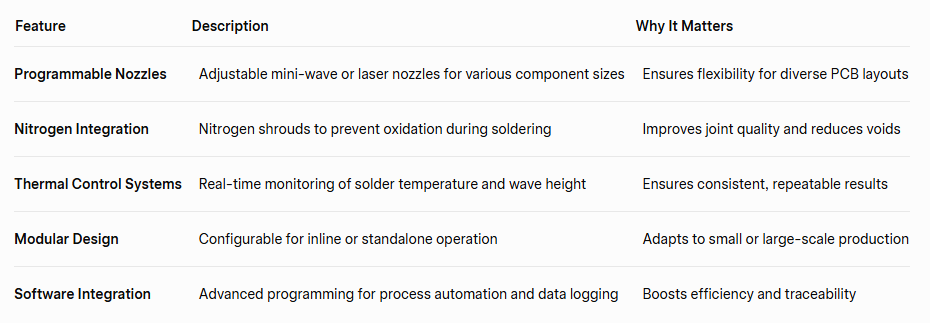
Must-Have Features
-
Versatility: Look for stations with interchangeable nozzles or multi-station setups to handle varying board sizes (e.g., up to 3,000mm lengths).
-
Automation: Systems with vision-guided alignment or robotic arms reduce operator intervention, improving throughput.
-
Void Reduction Technology: Advanced stations, like those from innovators such as Chengliankaida Technology Co., LTD, incorporate vacuum systems to minimize voids, critical for power devices.
-
Ease of Maintenance: Quick-change solder pots and self-cleaning nozzles reduce downtime.
These features ensure a selective soldering station can meet the demands of modern PCB assembly while maintaining cost-effectiveness.
How Do Selective Soldering Stations Address Common PCB Challenges?
PCB assembly faces challenges like void formation, thermal stress, and inconsistent solder joints, particularly in high-density or mixed-technology boards. Selective soldering stations tackle these issues head-on.
Reducing Void Rates
Voids in solder joints can compromise reliability, especially in power electronics like IGBT modules. Selective soldering stations use precise solder flow and nitrogen environments to minimize trapped gases. For advanced applications, systems like the Vacuum Reflow Soldering Oven employ vacuum chambers to further reduce voids, ensuring robust, hermetic joints.
Minimizing Thermal Stress
By targeting only specific joints, selective soldering stations avoid exposing sensitive SMT components to excessive heat, unlike wave soldering. Preheating controls and localized soldering also prevent warping or delamination of complex PCBs.
Ensuring Hermetic Sealing
In semiconductor packaging, hermetic seals are critical for protecting components from moisture and contaminants. Selective soldering stations with advanced fluxing and soldering precision ensure airtight joints, meeting stringent industry standards.
Supporting Lead-Free Soldering
With environmental regulations like RoHS, lead-free solders are standard. Selective soldering stations handle higher melting points and narrower process windows, ensuring compliance without sacrificing quality.
How to Choose the Right Selective Soldering Station for Your PCB Line?
Selecting the best selective soldering station depends on your production needs, budget, and technical requirements. Here’s a step-by-step guide to making an informed decision.
Step 1: Assess Your Production Needs
-
Board Complexity: High-mix, low-volume lines benefit from versatile stations with programmable nozzles.
-
Throughput: For high-volume production, prioritize inline systems with multi-station capabilities.
-
Component Types: Ensure compatibility with your PCB’s through-hole and SMT mix.
Step 2: Evaluate Technical Specifications
-
Board Size: Confirm the station supports your PCB dimensions (e.g., 50mm to 3,000mm).
-
Solder Types: Check compatibility with lead-free or specialty alloys for your industry.
-
Control Systems: Look for intuitive software with real-time monitoring and error detection.
Step 3: Consider Budget and ROI
-
Entry-Level Stations: Suitable for small-scale operations, starting at $50,000–$100,000, with basic automation.
-
High-End Systems: Advanced stations, like those from Chengliankaida Technology Co., LTD, cost $150,000+ but offer superior void reduction and integration, yielding 20–30% defect reductions and faster ROI.
-
Hidden Savings: Factor in reduced rework, material waste, and labor costs.
Step 4: Test and Validate
-
Request demos or trials to assess performance on your PCBs. Check for ease of setup, maintenance, and integration with existing lines.
FAQs for Buyers
What makes selective soldering better than wave soldering?
It offers precision for mixed-technology boards, reducing defects and thermal damage.
How do selective soldering stations improve yields?
By minimizing voids and ensuring consistent joints, they boost reliability by up to 25%.
Are these stations suitable for small businesses?
Yes, modular designs cater to both small and large operations.
What Are the Future Trends in Selective Soldering Stations?
The selective soldering industry is evolving rapidly, driven by advancements in electronics manufacturing and sustainability demands. Here are key trends shaping the future:
AI and Automation
Modern selective soldering stations integrate AI for predictive maintenance and process optimization. Machine learning adjusts solder parameters in real-time, reducing defects by up to 15% in high-mix environments.
Laser-Based Soldering
Laser selective soldering stations offer pinpoint accuracy for ultra-small components, gaining traction in 5G and IoT applications. They reduce thermal exposure, ideal for sensitive substrates.
Sustainability and Green Manufacturing
With stricter environmental regulations, selective soldering stations are adopting energy-efficient designs and lead-free solders. Systems like the Vacuum Reflow Soldering Oven minimize flux waste and energy use, aligning with eco-conscious standards.
Integration with Industry 4.0
Future stations will feature IoT connectivity for seamless data sharing across production lines, enabling real-time quality control and traceability.
Conclusion: Finding the Perfect Selective Soldering Station
Choosing the right selective soldering station is a game-changer for PCB assembly, offering precision, efficiency, and adaptability for modern electronics manufacturing. By focusing on features like programmable nozzles, nitrogen integration, and void reduction technology, you can select a system that meets your production needs and budget. As industries like semiconductors and automotive continue to grow, investing in a high-quality selective soldering station ensures your PCB line stays competitive. Explore options, test systems, and prioritize solutions that align with emerging trends like AI and sustainability for long-term success.
How Does Infrared Reflow Soldering Improve Semiconductor Packaging Efficiency?
What Is The Clearance For Selective Soldering?
Related Article

Explore laser packaging process routes for LiDAR and optoelectronics. Discover how vacuum eutectic soldering secures sub-micron alignment stability.
Laser Diode Packaging Technologies: From TO-Can to Silicon Photonics

Compare inline vs. batch vacuum soldering systems. Learn how vacuum reflow ovens optimize void-free welding for high-power semiconductor packaging.
Vacuum Soldering Process & Equipment Comparison: How to Achieve Automotive-Grade Low-Void Manufacturing

