What Is The Difference Between Infrared And Convection Reflow Oven?
author: Shirley Xie
2025-03-24
In the semiconductor packaging industry, reflow ovens are vital for soldering components onto substrates or PCBs, ensuring reliable electrical and thermal connections. Companies like Chengliankaida Technology Co., Ltd., established in 2007 and headquartered in Beijing’s Tongzhou district, specialize in advanced solutions such as the , designed for high-precision semiconductor device packaging. Two widely used reflow oven types—infrared (IR) and convection reflow ovens—differ fundamentally in their heat application methods and performance outcomes. These distinctions are critical for manufacturers aiming to optimize soldering processes, particularly in high-tech applications like power electronics and hermetic sealing. This article provides a detailed comparison of their differences, rooted in technical analysis.
Heat Transfer: Radiation vs. Convection
The core difference between infrared and convection reflow ovens lies in their heat transfer mechanisms. Infrared reflow ovens use radiant heat from IR lamps or ceramic heaters, transferring energy directly to surfaces via electromagnetic waves. This approach enables rapid temperature increases, appealing for processes needing quick cycles. However, its effectiveness depends on material properties—darker surfaces absorb heat well, while reflective ones, like metallic leads, may not, leading to potential inconsistencies.
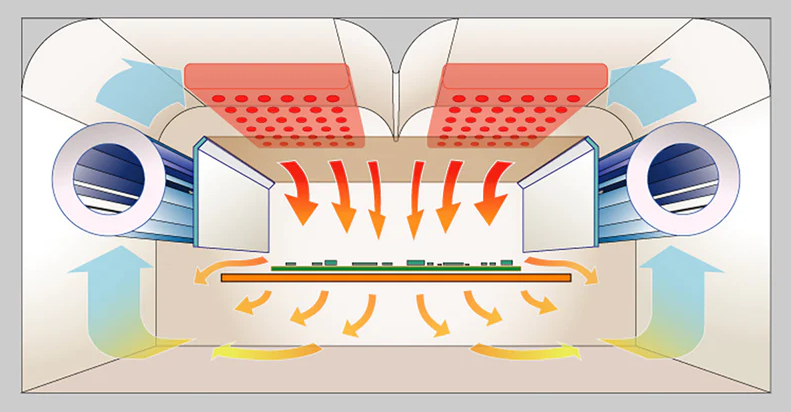
Convection reflow ovens, by contrast, employ a convective method, circulating heated air or gas (often nitrogen) with fans to deliver uniform heat across the assembly. This ensures consistent temperatures regardless of surface finish or component layout. For applications requiring precision—such as those supported by systems like the , which integrates advanced control for void reduction—this uniform heat transfer offers a significant advantage over infrared’s radiant approach.
How Do Infrared and Convection Reflow Ovens Differ in Heat Distribution?
Heat distribution is a decisive factor in achieving high-quality solder joints, especially in semiconductor packaging where uniformity is essential to avoid defects.
Infrared’s Uneven Heating Limitations
Infrared reflow ovens, despite their speed, often struggle with uneven heat distribution. The radiant energy’s line-of-sight nature means taller components can shadow smaller ones, while reflective surfaces absorb less heat. This variability can lead to hot spots or cold zones, posing challenges for complex assemblies like power devices or multi-layered PCBs. Such inconsistencies can complicate efforts to achieve the defect-free results targeted by advanced packaging technologies.
Convection Reflow Ovens’ Uniformity Strength
Convection reflow ovens overcome these issues by circulating hot air evenly throughout the chamber. This eliminates shadowing and ensures all components—regardless of size or position—reach the target temperature simultaneously. Multi-zone convection reflow ovens, with independent temperature controls, allow precise thermal profiling, from gradual ramp-up to controlled cooling. This precision is crucial for semiconductor packaging, aligning with the goals of uniform soldering and reliability pursued in cutting-edge manufacturing processes.
What Sets Convection Reflow Ovens Apart in Void Control?
Solder voids—gas pockets within joints—can degrade the performance of semiconductor devices, especially in power electronics like IGBTs. The ability to minimize voids highlights a key difference between these ovens.
Infrared’s Void Formation Challenges
Infrared reflow ovens heat rapidly, causing solder paste solvents to evaporate quickly. This sudden outgassing can trap gases, forming voids that weaken joint integrity. Uneven heating exacerbates this issue, as inconsistent temperatures disrupt solder flow. For applications demanding low void rates—such as those addressed by Chengliankaida’s innovations—this makes infrared ovens less suitable compared to alternatives designed for precision.
Convection Reflow Ovens’ Void Reduction Edge
Convection reflow ovens excel in void control thanks to their gradual, uniform heating. The steady airflow allows solvents to evaporate evenly, reducing gas entrapment. Many convection reflow ovens also support nitrogen atmospheres, minimizing oxidation and enhancing solder wetting, which further lowers void formation. This capability is vital for hermetic packaging, where airtight seals and robust joints are critical, aligning with the high standards of modern semiconductor production.
How Do Process Efficiency and Scalability Differ Between Infrared and Convection Reflow Ovens?
Efficiency and scalability are essential for manufacturers optimizing production, particularly in high-volume or varied applications.
Infrared’s Speed vs. Limited Flexibility
Infrared reflow ovens offer rapid heating, reducing cycle times and boosting throughput for simpler assemblies. However, their efficiency diminishes with complex designs due to fixed heating patterns and sensitivity to component layouts. The reliance on fragile IR lamps also increases maintenance demands, leading to downtime that can hinder scalability. For manufacturers aiming to expand operations, this lack of adaptability poses a limitation.
Convection Reflow Ovens’ Scalability and Energy Efficiency
Convection reflow ovens, though slower to reach peak temperatures, enhance process efficiency through versatility. Multi-zone designs enable tailored thermal profiles for diverse assemblies, from small SMDs to large power modules, without extensive adjustments. Air recirculation improves energy efficiency, cutting costs in high-throughput settings. With durable fan systems requiring less maintenance, convection reflow ovens support consistent production, making them a scalable choice for advanced manufacturing environments.
Why Do Material Compatibility and Atmosphere Control Differ Between Infrared and Convection Reflow Ovens?
Handling diverse materials and controlling the soldering environment further underscore the differences between these technologies.
Infrared’s Material Sensitivity Drawbacks
Infrared reflow ovens are highly sensitive to material properties. Assemblies with varied surface finishes—common in semiconductor packaging—pose challenges, as heat absorption differs significantly. Reflective metals like copper may underheat, while darker substrates overheat, risking damage. Operating typically in ambient air, infrared ovens also lack robust atmospheric control, increasing oxidation risks for sensitive components and limiting their suitability for high-reliability applications.
Convection Reflow Ovens’ Material and Atmospheric Advantages
Convection reflow ovens mitigate these issues with convective heating, which is less dependent on surface characteristics. Heat distributes evenly across mixed materials, requiring no special adjustments. Their compatibility with inert atmospheres like nitrogen reduces oxidation, improving joint quality and supporting hermetic sealing—crucial for power device packaging. This flexibility makes convection reflow ovens a stronger fit for advanced semiconductor processes.
Conclusion: Bridging the Gap Between Infrared and Convection Reflow Ovens
The distinctions between infrared and convection reflow ovens—spanning heat transfer, distribution, void control, efficiency, and material compatibility—reflect their unique strengths and weaknesses. Infrared ovens provide speed but lack uniformity and scalability, while convection reflow ovens offer precision, adaptability, and reliability, aligning with the needs of modern semiconductor packaging. For innovators like Chengliankaida Technology Co., Ltd., leveraging tools like the alongside convection reflow ovens can enhance efforts to address challenges like void rates and hermeticity. Understanding these differences enables manufacturers to optimize their processes, meeting the demands of an evolving global electronics landscape
What Is the Best Desktop Reflow Oven for PCB Assembly?
What Is Vacuum Reflow Soldering and Why Does It Matter?
Related Article

Learn how to choose a reliable vacuum reflow soldering factory, including lab support, customization, quality control, and global service.
How to Choose the Right Vacuum Reflow Soldering Partner

Explore advanced vacuum soldering solutions for IGBT modules in EVs and renewables, improving thermal performance, yield, and reliability.
Advanced Vacuum Soldering Solutions for Next-Gen IGBT Module Manufacturing