
A Comprehensive Guide to Reflow Soldering Machines in Electronics Manufacturing
2023-09-04
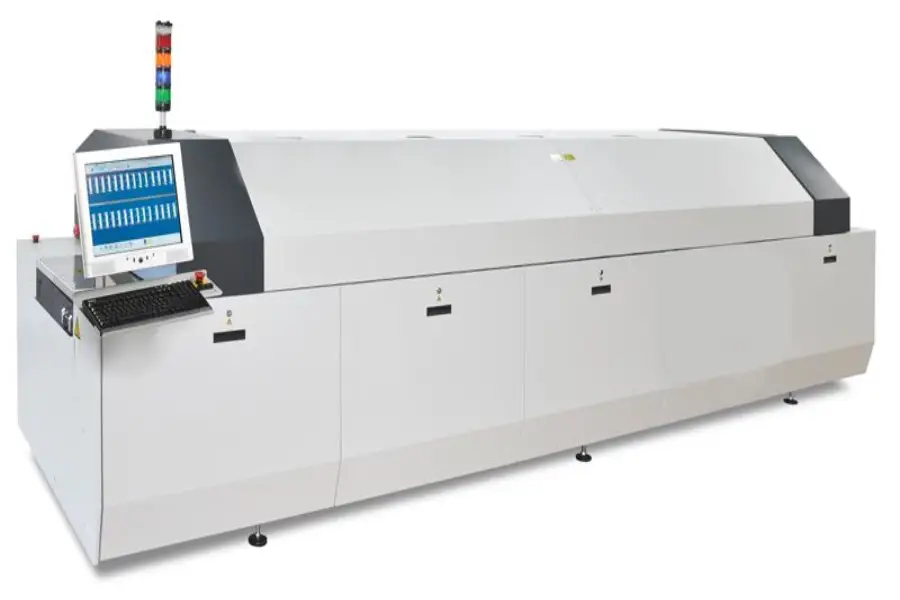
Reflow soldering machines are the unsung heroes of modern electronics manufacturing, enabling the seamless assembly of complex electronic components on circuit boards. These machines play a pivotal role in ensuring the reliability and functionality of countless electronic devices we use daily, from smartphones to laptops and beyond. In this comprehensive guide, we will delve into the world of reflow soldering machines, offering insights into their operation, the various types available, and how to choose the right one to meet specific manufacturing needs.
What Is Reflow Soldering Machine?
A reflow oven is a machine used primarily for reflow soldering surface mount electronic components to printed circuit boards (PCBs). An industrial reflow oven utilizing convection. When used in high-volume commercial applications, reflow ovens are constructed as long tunnels containing conveyor belts.
How Reflow Soldering Works?
Reflow soldering typically involves several heating stages, each with a specific purpose:
a. Preheating: In this stage, the PCB and components are gradually heated to a specific temperature to remove any moisture and prevent thermal shock. This prevents solder splattering and ensures even heating during the reflow process.
b. Solder Paste Melting: Once the preheating stage is complete, the temperature is raised to melt the solder paste. The solder paste transitions from a solid to a liquid state, allowing it to flow and make electrical connections.
c. Reflow Stage: During this stage, the temperature is raised further to a peak reflow temperature. This temperature is carefully controlled to avoid damaging components or the PCB. The solder paste reflows, creating solder joints between the component leads and the PCB pads.
d. Cooling: After reflow, the PCB and components are gradually cooled down to solidify the solder joints. Controlled cooling is essential to prevent thermal stress and maintain the integrity of the connections.
b. Solder Paste Melting: Once the preheating stage is complete, the temperature is raised to melt the solder paste. The solder paste transitions from a solid to a liquid state, allowing it to flow and make electrical connections.
c. Reflow Stage: During this stage, the temperature is raised further to a peak reflow temperature. This temperature is carefully controlled to avoid damaging components or the PCB. The solder paste reflows, creating solder joints between the component leads and the PCB pads.
d. Cooling: After reflow, the PCB and components are gradually cooled down to solidify the solder joints. Controlled cooling is essential to prevent thermal stress and maintain the integrity of the connections.
Types of Reflow Soldering Machines
Reflow soldering is a critical process in electronics manufacturing, and there are various types of reflow soldering machines designed to meet specific requirements and production needs. Here are some common types of reflow soldering machines:
Convection Reflow Ovens:
Convection reflow ovens are the most widely used type of reflow soldering machine. They rely on heated air circulation to melt the solder paste and create solder joints.
Pros: Versatile, suitable for various component sizes, and cost-effective.
Cons: Limited control over the heating process, may require longer cycle times.
Pros: Versatile, suitable for various component sizes, and cost-effective.
Cons: Limited control over the heating process, may require longer cycle times.
Infrared (IR) Reflow Soldering Machines:
Infrared reflow soldering machines use infrared radiation to heat the solder paste and components. IR reflow is known for its rapid heating and cooling cycles.
Pros: Faster processing, precise temperature control, suitable for lead-free soldering.
Cons: Limited penetration for large components and thermal challenges with certain component materials.
Pros: Faster processing, precise temperature control, suitable for lead-free soldering.
Cons: Limited penetration for large components and thermal challenges with certain component materials.
Vapor Phase Reflow Machines:
Vapor phase reflow machines utilize a special liquid with a precisely defined boiling point to create a vapor atmosphere. Components are soldered when they reach the vapor's temperature.
Pros: Extremely precise temperature control, suitable for lead-free soldering, and excellent for temperature-sensitive components.
Cons: Higher initial cost, longer cycle times, and potential challenges with tall components.
Pros: Extremely precise temperature control, suitable for lead-free soldering, and excellent for temperature-sensitive components.
Cons: Higher initial cost, longer cycle times, and potential challenges with tall components.
Forced Convection Reflow Ovens:
Forced convection reflow ovens combine convection heating with additional forced air circulation for improved temperature control and uniformity.
Pros: Better control over the reflow process, reduced risk of overheating sensitive components, and faster cycle times compared to standard convection ovens.
Cons: Higher initial cost.
Pros: Better control over the reflow process, reduced risk of overheating sensitive components, and faster cycle times compared to standard convection ovens.
Cons: Higher initial cost.
Choosing the Right Reflow Soldering Machine
There are many factors to consider when selecting a reflow oven, including production volume, budget, and specific process requirements. The reflow oven calibration and maintenance are critical in ensuring optimal solder joint quality.
Assessing Production Volume
Assessing Production Volume
We'll guide businesses in evaluating their production requirements, helping them determine whether a batch or inline reflow soldering machine is more suitable.
- Budget Considerations
Discussing the cost factors involved, we'll provide insights into budget allocation and cost-saving strategies when selecting a reflow soldering machine.
- Technology Requirements
Exploring the significance of technology compatibility, we'll explain how choosing the right machine ensures compatibility with specific solder pastes and component sizes.
- Customization and Versatility
Highlighting the importance of machine flexibility, we'll delve into the benefits of customizable options to adapt to evolving manufacturing needs.
- Reliability and Maintenance
We'll emphasize the significance of selecting a reliable manufacturer and the need for regular maintenance to ensure consistent performance.
- Industry Standards and Regulations
Discussing the relevance of adhering to industry standards and regulations, we'll provide guidance on compliance considerations.
Reflow Oven Zones
Reflow ovens are usually divided into several zones, each with an independently controlled temperature setting. As a result of these zones, a precise and uniform temperature profile is achieved during the reflow process. A typical reflow oven has the following zones:
- Preheating Zone:In the reflow oven, the preheating zone is responsible for gradually raising the temperature of the PCB assembly. This prevents thermal shock, which could damage sensitive components. It is crucial to monitor the rate at which the temperature increases in this zone, since too rapid heating could result in component warping, while too slow heating could lead to solder paste drying. A preheat rate of between 1 and 3°C per second is ideal.
- Soaking Zone: In the soaking zone, the temperature is maintained at a constant, allowing the PCB assembly to reach a uniform temperature. This phase ensures that the flux in the solder paste activates and removes oxides from the surfaces. In order to achieve consistent solder joint quality, the soaking zone must be maintained, as it minimizes temperature variations throughout the PCB assembly.
- Reflow Zone: Reflow occurs at a peak temperature, which melts the solder paste and forms a strong metallurgical bond between the PCB pads and the component leads. A solder paste's peak temperature typically ranges from 235°C to 250°C. To ensure optimal solder joint formation without damaging components or causing other solder-related defects, this temperature must be maintained within a specified range and duration.
- Cooling Zone: When the solder joints are solidified, the temperature is rapidly lowered in the cooling zone of the reflow oven. The intermetallic compound formation can be prevented by a controlled cooling rate. A rapid cooling rate can cause thermal soak, while a slow cooling rate can cause brittle solder joints. An ideal cooling rate is between 2°C and 4°C per second.
Reflow ovens can have different number of zones depending on their model and manufacturer. In addition to providing increased control over the reflow process and ensuring consistent solder joint quality, advanced reflow ovens may contain additional zones or sub-zones for fine-tuning the temperature profile.
A Guide to Creating an Effective Process for Reflowing Formic Acid
A Guide to Successfully Using Vacuum Reflow Ovens in SMT Soldering
Related Article

Explore laser packaging process routes for LiDAR and optoelectronics. Discover how vacuum eutectic soldering secures sub-micron alignment stability.
Laser Diode Packaging Technologies: From TO-Can to Silicon Photonics

Compare inline vs. batch vacuum soldering systems. Learn how vacuum reflow ovens optimize void-free welding for high-power semiconductor packaging.
Vacuum Soldering Process & Equipment Comparison: How to Achieve Automotive-Grade Low-Void Manufacturing

